CALVIN GOZÉ
About My New Website
Feb 08, 2026
Are you tired of massive tech companies paywalling the internet? Have you ever wanted to host a website from your living room?
Recently, Google Firebase moved their only free plan to a pay-as-you-go plan. That meant the hosting for my old personal website, calvingoze.me, was no longer free. Compounding this, the website's content was outdated and I wasn't happy with the framework. This led me to search for alternatives.
The goal was simple: find a free hosting alternative combined with a flexible lightweight framework. Additionally, I wanted to change the tone of my site from an online resume, to an advertisement for my consulting services as a Professional Engineer.
The idea of self hosting strongly appealed to me, not only for being free and unbound by big tech companies, but also being a tremendous learning experience. After much research, I decided on a linux server using a Raspberry Pi computer board. I could incorporate this little computer board into a fun/decorative design displayable in my living room complete with a little dashboard displaying server stats.
Below is a picture of my webserver in my living room. I sourced the Pi and OLED display from adafruit.com for under $200.
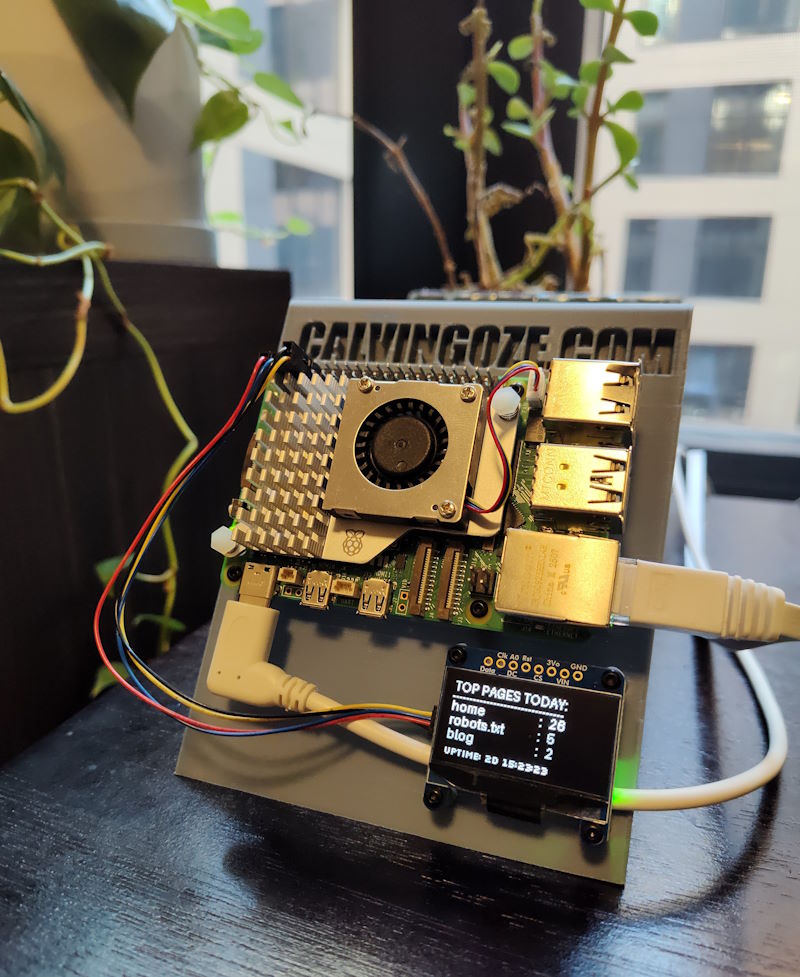
This site, calvingoze.com, runs off of a tiny Raspberry Pi5 running a headless Raspberry Pi Lite OS. It uses the Python based Flask framework and is served via Gunicorn and Nginx. The dynamic content and analytical data on this site are stored in SQLite databases. My source code for the site can be found here: https://github.com/calvingoze/personal-flask-website. The physical raspberry pi is mounted to a decorative stand designed in FreeCAD and 3d printed with a Bambu Lab A3. As a creative way to show server status and web analytics, the stand has a small OLED dashboard that displays the current top page hits today along with server uptime status. The webserver and OLED are controlled by simple/robust linux daemon services.
While self hosting is free and exciting, it comes with a massive set of responsibilities. How will you manage SSL certificates? How will you prevent malicious attacks like DDoSing, exploitative bots, or people spamming your contact form? Thankfully many of these issues are solved by my domain name service, Cloudflare, via a Cloudflare tunnel. This service not only protects against most malicious attacks, but also gives me a free and secure connection to the open internet without exposing my public IP address.
This self hosting journey has been extremely educational and satisfying. All of the technologies used to build this site are cheap/free, open source, and accessible to anyone. While much of IT and technology these days can feel gatekept and paywalled, this experience has taught me that there is always an open source option for those willing to learn and do the research.